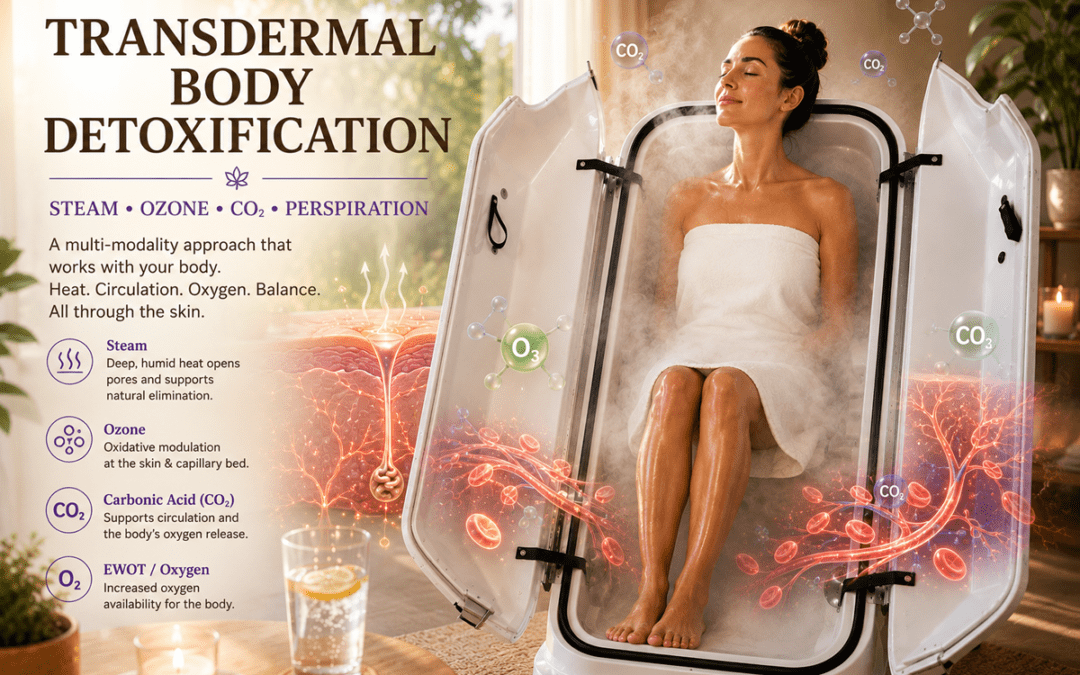
Transdermal Body Detoxification
Steam, Ozone & Carbonic Acid vs. Infrared — Basis, Foundation, Efficiency & Protocol
The Skin as a Detox Organ
The skin is the body’s largest organ and one of its most accessible organs of elimination. Its eccrine sweat glands do more than regulate temperature — they excrete a measurable load of lipophilic toxicants. Research has documented arsenic, cadmium, lead, mercury, and various persistent organic pollutants in sweat, in some cases at concentrations exceeding what shows up in blood or urine.
This route of elimination is particularly interesting because many of the body’s other detoxification pathways depend upon liver function, bile flow, gastrointestinal and kidney function, nutritional status, enzymes and other biochemical processes that can vary considerably from person to person. Sweating, by contrast, provides an elimination pathway that can be deliberately stimulated from the outside and, for many people, incorporated into a home wellness routine without complex procedures.
This is the physiological basis for any sauna-based detox protocol: mobilize what’s stored in fat and interstitial tissue, then excrete it through the skin.
But how you generate that sweat response — and what else you layer into the session — changes both the efficiency and the safety profile considerably.
Why We Moved Away from Infrared Sauna
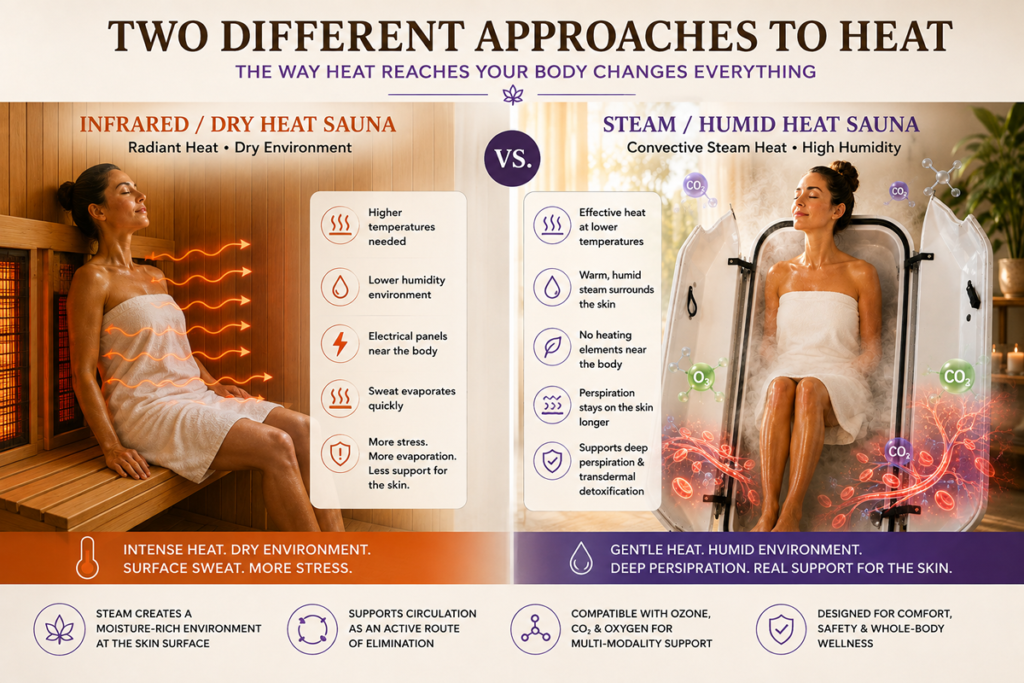 Infrared sauna technology has been the default in the wellness space for years, largely because it heats tissue directly rather than heating the surrounding air. But infrared heating elements are electrical devices sitting in close proximity to the body for extended periods, and that proximity means measurable electromagnetic field (EMF) exposure throughout the session.
There’s a growing body of practitioner concern — grounded in the Cell Danger Response (CDR) framework first articulated by Dr. Robert Naviaux — that chronic or repeated low-level cellular stressors, EMF among them, can lock mitochondria into a persistent defensive posture rather than allowing them to return to normal metabolic function.
It’s worth being clear-eyed here: the CDR model itself is a serious area of metabolic research, but the specific link between everyday EMF exposure and CDR activation is not something with settled clinical consensus — it’s an area of ongoing debate and emerging hypothesis, not established fact.
Still, for a modality whose entire premise is reducing cellular burden, we questioned the logic of introducing unnecessary near-body electrical exposure throughout every session.
That tension is why steam-based delivery — with no adjacent heating elements required inside the cabin — became the more coherent foundation for us.
The Foundation: Humid Steam Sauna Heat Instead of Infrared Sauna Radiant Heat
Steam saunas heat the body through humid convective heat rather than direct infrared radiation.
The high-humidity environment reduces the evaporation of sweat from the skin, allowing significant thermal effects to occur at considerably lower ambient temperatures than those commonly used in traditional dry saunas.
Just as importantly for a transdermal approach, steam creates an entirely different skin environment. Warm water vapor continuously surrounds the body rather than relying predominantly on perspiration to create moisture at the skin surface. High-humidity conditions influence hydration of the stratum corneum — the outermost layer of the skin — which is particularly relevant when the skin itself is being used as the interface for a wellness modality.
Practically, this means:
Significant perspiration at lower ambient temperatures
- A continuously warm, moisture-rich environment around the skin
- No reliance on embedded electrical heating panels near the body
- A natural steam medium through which compatible aromatic compounds and essential oils can also be dispersed
This makes steam a particularly interesting foundation for transdermal wellness work. But the real efficiency gain comes from what the steam environment allows you to layer into the session alongside heat and perspiration.
Layering in Ozone
Ozone delivered via steam — rather than dry ozone insufflation — allows for transdermal exposure at the skin and capillary bed.
The proposed mechanism is oxidative modulation: mild, controlled oxidative stress that stimulates localized circulation and is theorized to influence the same lipid-peroxidation pathways involved in mobilizing stored toxicants from fat tissue.
It’s the least clinically mature of the three modalities discussed here — the evidence base leans heavily on practitioner experience and mechanistic plausibility rather than large randomized trials — so it’s the layer that calls for the most conservative dosing and the most careful language around what it can and can’t be claimed to do.
In a head-out steam sauna, the body is exposed within the ozone-steam environment while the head remains outside the chamber — an important distinction in a modality where ozone is intended for interaction with the body rather than deliberate inhalation.
Layering in Carbonic Acid (CO₂)
This is the modality with the strongest supporting literature, particularly from European and Japanese balneotherapy research on carbonic acid baths.
When CO₂ is dissolved into the steam/water medium, it diffuses trans dermally and raises local tissue CO₂ concentration. That shift triggers the Bohr effect: haemoglobin releases oxygen more readily into the surrounding tissue in response to elevated CO₂.
The result is measurable local vasodilation and increased tissue oxygenation — a mechanism entirely independent of heat or ozone.
It’s an active circulatory driver rather than a passive, heat-induced one, which is what makes it such a strong pairing with oxygen-based therapies like EWOT (Exercise With Oxygen Therapy):
the CO₂-driven Bohr effect creates a compelling physiological rationale for combining enhanced oxygen availability Infrared Saunas vs. Multi-Modality Steam Sauna with mechanisms that encourage oxygen unloading into tissue.
Infrared Saunas vs. Multi-Modality Steam Sauna
A General Session Structure
- Pre-session Hydrate with electrolytes, dry-brush skin if desired as part of the individual’s wellness routine.
- Phase 1 (0–10 min) Steam ramp to establish a humid heat baseline.
- Phase 2 (10–25 min) Carbonic acid (CO₂) introduced; this is the window for pairing with EWOT if oxygen therapy is part of the protocol.
- Phase 3 (optional, 25–35 min) Ozone steam exposure, conservatively dosed.
- Post-session Cool-down, full electrolyte replacement, shower to clear surface residue.
- Frequency
Start at 2–3x/week and build tolerance before increasing, since the combined oxidative and thermal load is a heavier physiological stimulus than heat alone.
Session temperature, duration and the introduction of additional modalities should always be adjusted to individual tolerance rather than treating one protocol as appropriate for everyone.
The Bottom Line
Sweat-based detox has real physiological grounding, but not all sauna technologies get you there the same way.
Replacing infrared’s radiant, EMF-adjacent heat with humid steam removes the need for near-body infrared heating elements from a protocol whose purpose is reducing cellular burden — and it opens the door to layering in carbonic acid and ozone, two modalities that work through entirely different physiological channels than heat alone.
Steam also creates a distinctly different environment at the skin itself: warm water vapor, high humidity and reduced evaporation maintain a moisture-rich interface through which heat, CO₂, ozone and compatible aromatic compounds can be incorporated into a single session.
The result isn’t just “more sweating.”
It’s a session built on multiple, distinct mechanisms working together: thermal, transdermal, circulatory and oxidative.
Exploring a Different Approach to Sauna Therapy
Recover U was developed around the idea that a sauna can be more than a source of heat. Its head-out, fiberglass steam environment was designed to provide a practical platform for combining steam with complementary modalities including ozone, CO₂ and oxygen-based wellness approaches.
Learn how the Recover U head-out steam sauna works.
Explore ozone, CO₂ and oxygen-based wellness modalities.
Have questions about building a home or professional multi-modality system? Contact Recover U.
References & Further Reading
- Sears ME, Kerr KJ, Bray RI. Arsenic, cadmium, lead, and mercury in sweat: a systematic review. Journal of Environmental and Public Health. 2012;2012:184745. PMID: 22505948.
View on PubMed - Genuis SJ, Birkholz D, Rodushkin I, Beesoon S. Blood, urine, and sweat (BUS) study: monitoring and elimination of bioaccumulated toxic elements. Archives of Environmental Contamination and Toxicology. 2011;61(2):344–357. PMID: 21057782.
View on PubMed - Idson B. Hydration and percutaneous absorption. Current Problems in Dermatology. 1978;7:132–141. PMID: 752449.
View on PubMed - Law RM, et al. Twenty clinically pertinent factors/observations for percutaneous absorption in humans. American Journal of Clinical Dermatology. 2020. PMID: 31677110.
View on PubMed - Hartmann BR, Bassenge E, Pittler M. Effect of carbon dioxide-enriched water and fresh water on the cutaneous microcirculation and oxygen tension in the skin of the foot. Angiology. 1997;48(4):337–343. PMID: 9112881.
View on PubMed - Finzgar M, Melik Z, Cankar K. Effect of transcutaneous application of gaseous carbon dioxide on cutaneous microcirculation. Clinical Hemorheology and Microcirculation. 2015;60(4):423–435. PMID: 25261433.
View on PubMed - Valacchi G, Fortino V, Bocci V. The dual action of ozone on the skin. British Journal of Dermatology. 2005;153(6):1096–1100. PMID: 16307642.
View on PubMed

Recover U Technologies and Services Inc.
Maya Fabiszak, Director, Certified Oxidative Therapies Specialist, Certified Nutritionist & Environmental Lifestyle Counselor, phone 647.909.7419
Ewa Pringle, Cofounder, phone 289.217.5552
Websites:
Recover U Technologies and Services Inc.
Swiss Bionic Solutions
Facebook
Instagram
Twitter
YouTube
Pinterest
Google page
TickTock